University with a Remarkable Heritage
Founded in 1826, University College London (UCL) celebrated its bicentenary in 2026, marking two centuries of pioneering discoveries and an intellectual heritage that includes distinguished thinkers and 33 Nobel laureates. Ranked joint eighth university in the world, UCL brings together diverse academic, research and professional-services communities, creating an exceptionally rich and intellectually stimulating environment in which to explore and develop leadership.
From our first meeting with UCL’s Organisational Development (OD) team, we knew this would be a special partnership and a project deeply connected to our passion for leadership development. The client team’s commitment to its people, clarity of ambition and the warmth and openness with which they invited us to work alongside them set the tone for a collaboration we would come to value enormously.
Programme at a Glance
- Client: Global Top 8 University*
- Our Delivery Team: A team of ten including eight leadership coaches/facilitators and two programme assistants
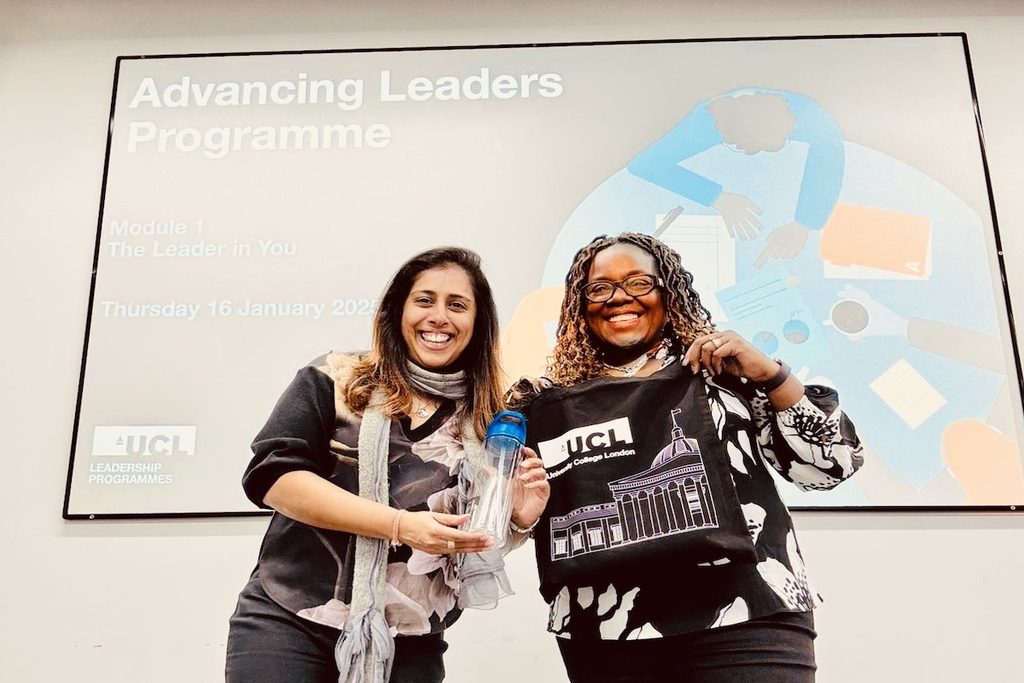
- Programmes: Strategic Leaders Programme, Advancing Leaders Programme
- Cohorts: Grade 7 and Grade 8 managers from academic, research and professional-services communities
- Timeframe: 4 year partnership, 9-month leadership journey for each cohort
- Format: In-person and virtual sessions, group learning, 360 feedback session, self-paced resources
- Number of workshops: 154
- Highest Recorded Feedback Module Score: 9.64/10 for Creating an Inclusive Culture (ALP), 9.60/10 for Leading Change (SLP)
- Reach: 660 leaders

The Brief
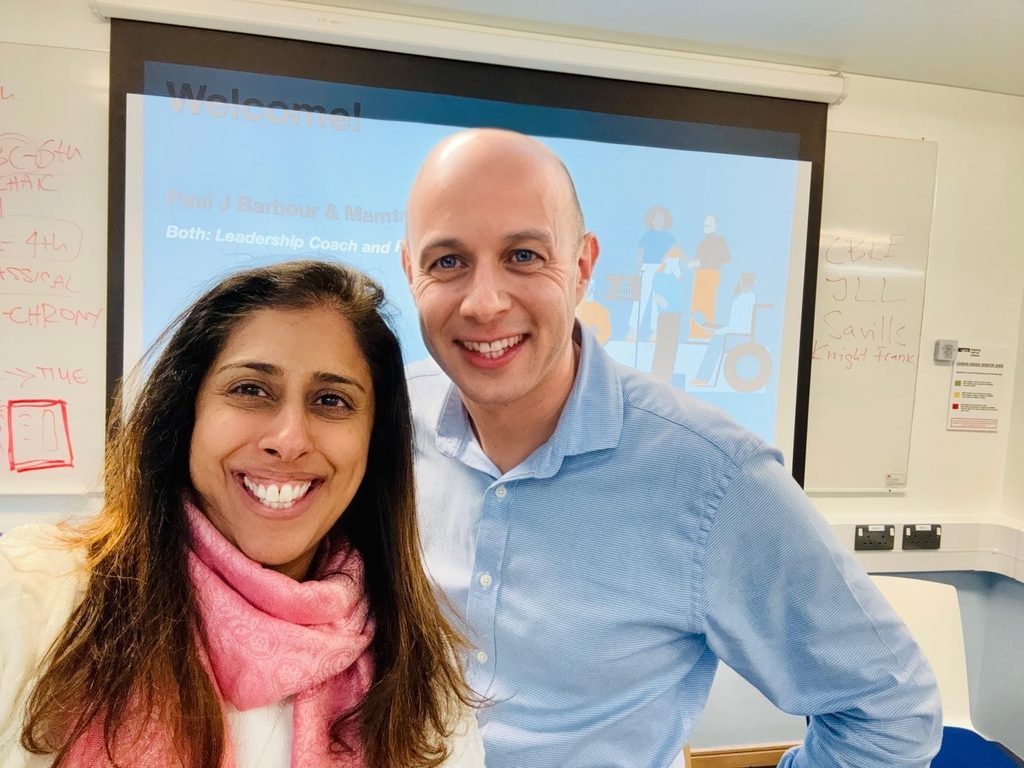
UCL had a clear ambition: to elevate leadership potential, stretch horizons and strengthen its pipeline of future leaders. As part of a wider review of leadership development, UCL’s Organisational Development team listened carefully to colleagues across the university through workshops and wider stakeholder consultation. A clear need emerged for greater support at two key career transitions: when high-performing colleagues take their next step, often into management, and when established middle managers take on broader, more strategic responsibilities. These transitions were significant in both academic and professional services careers.
The vision was to equip colleagues with practical leadership skills while cultivating a leadership mindset that would shape how they approached their work every day. UCL wanted people to recognise their capacity to influence, take ownership and collaborate, regardless of formal authority. By nurturing this potential across a substantial part of the university, UCL sought to develop the leadership talent needed for the future.
To realise this ambition, UCL partnered with Lazarus & Maverick to co-create two distinct programmes: Advancing Leaders and Strategic Leaders. The OD team’s insights provided a strong foundation for the collaboration. Our shared task was to combine fresh perspectives on leadership with a deep understanding of higher education and UCL’s own context, creating programmes that would stretch participants’ thinking, build their confidence and elevate their leadership potential.
“A couple of features set Lazarus and Maverick apart from other learning providers we were in discussions with, one in particular being their willingness and approach to co-creating the programme with us. We worked closely together over a period of several months to develop a programme that was innovative, impactful and grounded in our particular context and were thrilled with both the process and outcome.
Catherine Stow, UCL Organisational Development
Alex and the team are also excellent coaches.”
The Design: 14 Modules, 154 Workshops
Over several months, Lazarus & Maverick worked closely with UCL’s Organisational Development team to turn this ambition into two substantial leadership programmes. Building on UCL’s consultation findings and deep knowledge of its people, we created 14 modules, seven for each programme. These became the foundation for 154 facilitated workshops over four years.
Each programme had its own learning journey shaped around the realities of a complex university. Drawing on leadership psychology, coaching, team development and organisational behaviour, the modules explored themes such as leadership identity and resilience, leading and developing others, high-performing teams, inclusive leadership, influencing beyond one’s role, strategic thinking and leading through change. Practical skills sat alongside deeper reflection on values, behavioural tendencies, relationships, the choices people make at work and what changes when we adopt systems thinking.
We wanted colleagues to explore what leadership meant in their own circumstances, question familiar assumptions and try new ways of approaching their responsibilities with curiousity and courage to test and apply their learning. Facilitated discussions, practical exercises, peer learning and reflection were woven throughout both programmes.
Learning carried on between workshops. Face-to-face and virtual sessions were supported by self-directed learning and opportunities to put new ideas into practice. UCL’s own 360-degree feedback tool was built into the programmes throughout one of the programmes, with coaching conversations that helped participants explore their strengths, understand how others experienced them and identify areas for development.
“Lazarus & Maverick brought fresh ideas, agile thinking and spent time to really understand the world of Higher Education and the context within which our managers need to lead and make decisions.”
Catherine Stow, UCL Organisational Development
Learning With and From One Another
Each cohort brought together academics, researchers and professional services colleagues from across UCL. In a university of such breadth and complexity, this mix offered something particularly valuable: the chance to see beyond one’s own department, understand different perspectives and build connections across the institution. It also reflected UCL’s wider ambition to encourage collaboration and a sense of shared responsibility beyond formal organisational boundaries.
This diversity was itself a rich source of learning. Participants could explore how leadership looked from other parts of the university, hear unfamiliar viewpoints and gain a broader understanding of UCL beyond their own areas of work. The experience also created opportunities to build relationships with colleagues they might rarely have worked with otherwise.
We worked hard to create an open, thoughtful learning environment. Facilitators encouraged curiosity, constructive challenge and genuine listening. Participants could question their assumptions without feeling they had to have all the answers. The faculty were not the only experts in the room; the programmes drew on participants’ existing knowledge while introducing fresh perspectives and challenging them to think differently. As cohorts progressed, colleagues revisited ideas, shared experiences and brought fresh questions from their everyday work. Learning became an ongoing conversation. One participant captured the experience particularly well:
“What I loved is that it never felt like learning (even though I like learning!) but at the end of each session you would realise how much ground we had covered.” – Programme Participant
The Power of 360-Degree Feedback
An important part of the Strategic Leaders Programme was the opportunity to understand leadership through the eyes of others. UCL’s existing 360-degree feedback tool invited perspectives from line managers, colleagues, team members and collaborators, offering participants a fuller picture of how their leadership was experienced. The feedback helped them recognise strengths worth celebrating, as well as areas where they might want to grow.
Receiving 360-degree feedback is not always easy. There can be anticipation, vulnerability and sometimes surprise in discovering how others perceive us, particularly when their views differ from our own. The value lies not simply in receiving the feedback, but in having the space to make sense of it.
This was where coaching became particularly important. Our coaches helped participants approach their feedback with openness rather than defensiveness, explore what resonated or challenged them, and connect their insights to the wider programme and their everyday working lives.
When asked what they valued most about the process, one participant answered simply: “Learning how others perceive you”. Another reflected that “The 360 especially was extremely thought provoking and I expect to get much use out of the feedback”.
The conversations themselves also mattered. One participant described how “The debriefing session was extremely useful. The coach provided me with some practical/ implementable tips as well as starting me on a self-reflective journey.” Another described the more personal significance of the experience: “The 360 review and session with you was incredibly helpful. To have the opportunity to discuss and reflect on this feedback with you felt like a therapy session, and I honestly think it will be a transformational tool in helping me to develop in the areas I have found challenging for a long time.”
For us, the purpose was never to reduce leadership to a set of scores. It was to help colleagues recognise what they were already doing well, consider perspectives they might not otherwise encounter and make more informed choices about how they wanted to lead.
“We have had excellent feedback from participants who they (Lazarus & Maverick faculty) have coached around this, helping them to unpack the feedback, deepen their learning and identify further areas for development.”
Catherine Stow, UCL Organisational Development
The Story Behind the Feedback Scores
Looking across the evaluations available to us, we were curious not only about which modules received the highest participant feedback scores of 9 out of 10, and what participants particularly appreciated about the learning.
The pattern is interesting: high ratings appeared in areas concerned with understanding oneself, developing others, navigating complex relationships and approaching leadership more strategically.
Among the highest-rated Advancing Leaders modules were Creating an Inclusive Culture (9.64/10), Strategic Thinking & Techniques (9.43/10) and Translating Strategy into Action (9.42/10). The Leader in You also attracted strong feedback of 9.20/10 in one cohort, as did Leading and Developing Others, which scored above 9 in several recorded deliveries.
The comments help explain some of this appreciation. Participants particularly welcomed practical tools, opportunities to discuss real situations and the chance to think differently about their responsibilities. Reflecting on Leading and Developing Others, one participant wrote: “Great session again – thank you! Definitely feels immediately applicable, some really useful methodologies too.”
Another, commenting at the end of Translating Strategy into Action, described the wider experience:
“It’s a great confidence builder as it demystifies leadership and gives you a practical toolkit to use to help present yourself as a leader and deal with difficult situations.” – Programme Participant
There was a strong response to the facilitation, too. Following The Leader in You, a participant wrote: “Really useful and interesting day. Mamta was fab.”
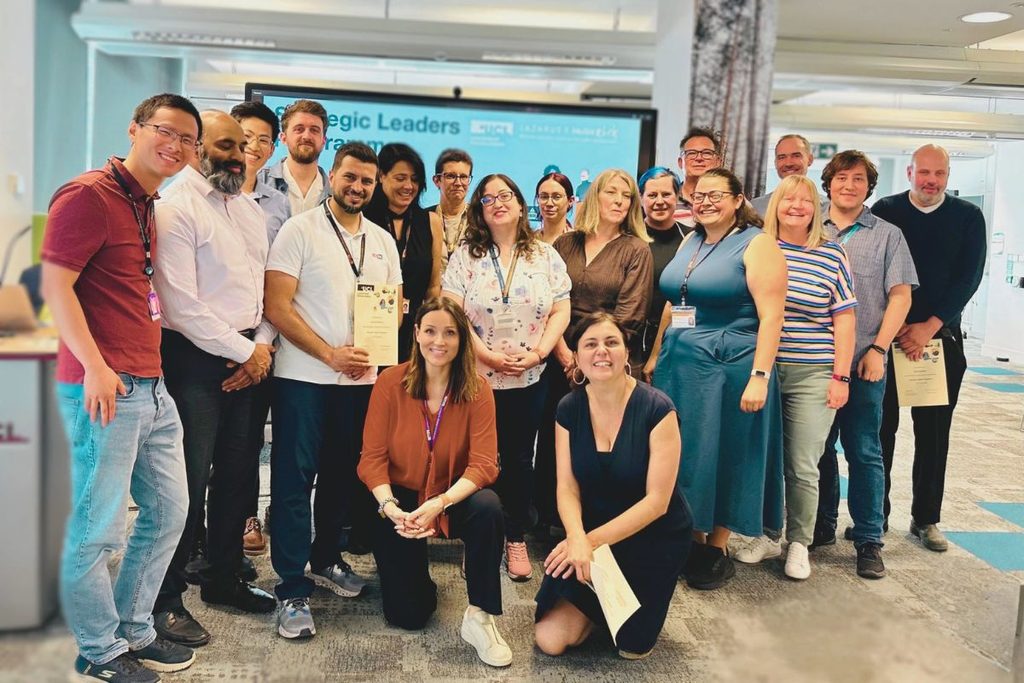
In Strategic Leaders, Unlocking Potential Through Coaching was a recurring high performer, with scores including 9.33, 9.15, 9.11 and 9.10 out of 10 across different cohorts. In feedback from one delivery facilitated by Danny Sweeney, a participant observed: “There were some really interesting points discussed and a paradigm shift.” Another wrote: “Danny is an excellent communicator. He did an excellent demonstration in coaching during class and gave us lots of tips during the Q and A session.”
My Leadership Identity was also highly rated, reaching 9.29/10 in one cohort and 9.17/10 in another. One participant described leaving a session feeling “inspired to consider my leadership identity.” Other notable scores included 9.50/10 for Influencing and Wider Impact, 9.47/10 for Courageous Leadership in an earlier programme version, and 9.60/10 for Leading Change with the following feedback from one of the attendees:
“It offers some really good new ways of thinking and a chance to step back from day to day work and look at the bigger picture and how you can improve your work.” – Programme Participant
Beyond the scores, the written feedback offers a richer picture of what participants valued. A recurring theme is the combination of fresh perspectives and practical relevance: opportunities to understand themselves better, question familiar assumptions, practise new approaches and consider how to apply their learning in everyday working life.
A Partnership Built on Shared Commitment
Behind the programmes was a close and rewarding relationship between UCL’s Organisational Development team and Lazarus & Maverick’s team of coaches, facilitators, programme designers and coordinators. UCL brought a clear vision, a deep understanding of its people and a genuine commitment to their development. L&M brought complementary expertise in leadership psychology, coaching, team effectiveness and organisational development, alongside the people and resources needed to bring the programmes to life.
Designing the programmes was one undertaking. Delivering them across successive cohorts over four years gave us the opportunity to deepen our understanding of UCL and the people who work there. Each cohort brought different experiences, responsibilities and perspectives. By listening to participants’ feedback and constructive suggestions, we gained a richer understanding of their everyday challenges and learning needs. These insights informed our continuing conversations with UCL’s OD team and helped us keep the learning relevant and responsive.
Our faculty brought different expertise and facilitation styles, united by a commitment to thoughtful, engaging and practically useful learning. We wanted participants to feel supported while also challenging them to stretch their thinking and try unfamiliar approaches. That balance came through in the feedback. One Strategic Leaders participant described a session with Alex as “sometimes challenging but in a good way”, adding that “Alex was brilliant and really brought this topic to life.” Another, reflecting on a Leading Change session facilitated by Danny, praised the “Very professional, capable and empathic delivery” and described how role play pushed participants out of their comfort zones. Following a session attributed to Paul, one participant observed: “The facilitator as always was great and provided some thought-provoking pearls of wisdom.” And following a coaching module, another wrote simply: “I absolutely loved it !! Thank you so much Julie.”
Leadership for Today, Readiness for Tomorrow
At the heart of the partnership was UCL’s ambition to invest in the leadership potential of its people, strengthen its pipeline of future leaders and prepare colleagues for the responsibilities ahead. Equally important was cultivating a leadership mindset that extended beyond job titles and formal authority, encouraging people to take ownership, collaborate across boundaries and recognise the difference they could make in their everyday work. Together, these ambitions reflected UCL’s commitment to developing the talent and leadership capacity it would need for the future.
“Our ambition was to provide our high performing managers and those stepping into management, with some best in class development opportunities and to grow our pipeline of future leaders across the organisation and our partnership with L&M has provided exactly that.”
Catherine Stow, UCL Organisational Development
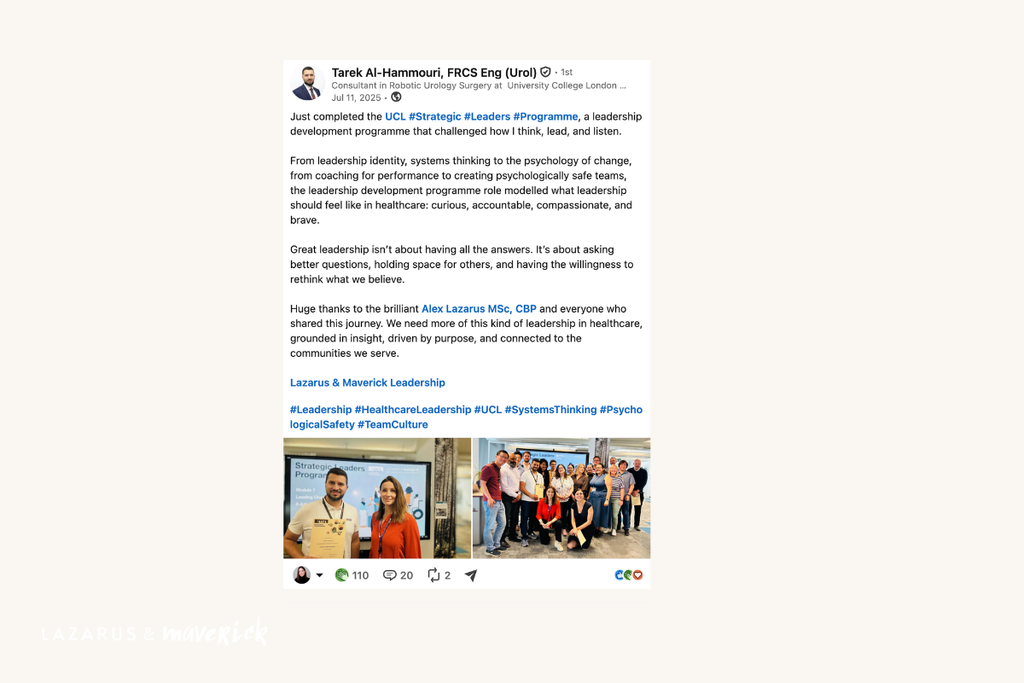
Social Media Feedback – Thank you!